
How to Know If Your Sales Boy Is Stealing From You (And How to Stop It)
Staff theft is one of the biggest silent killers of Nigerian trader businesses. Here's how to spot it, prove it, and build a system that makes it nearly impossible.
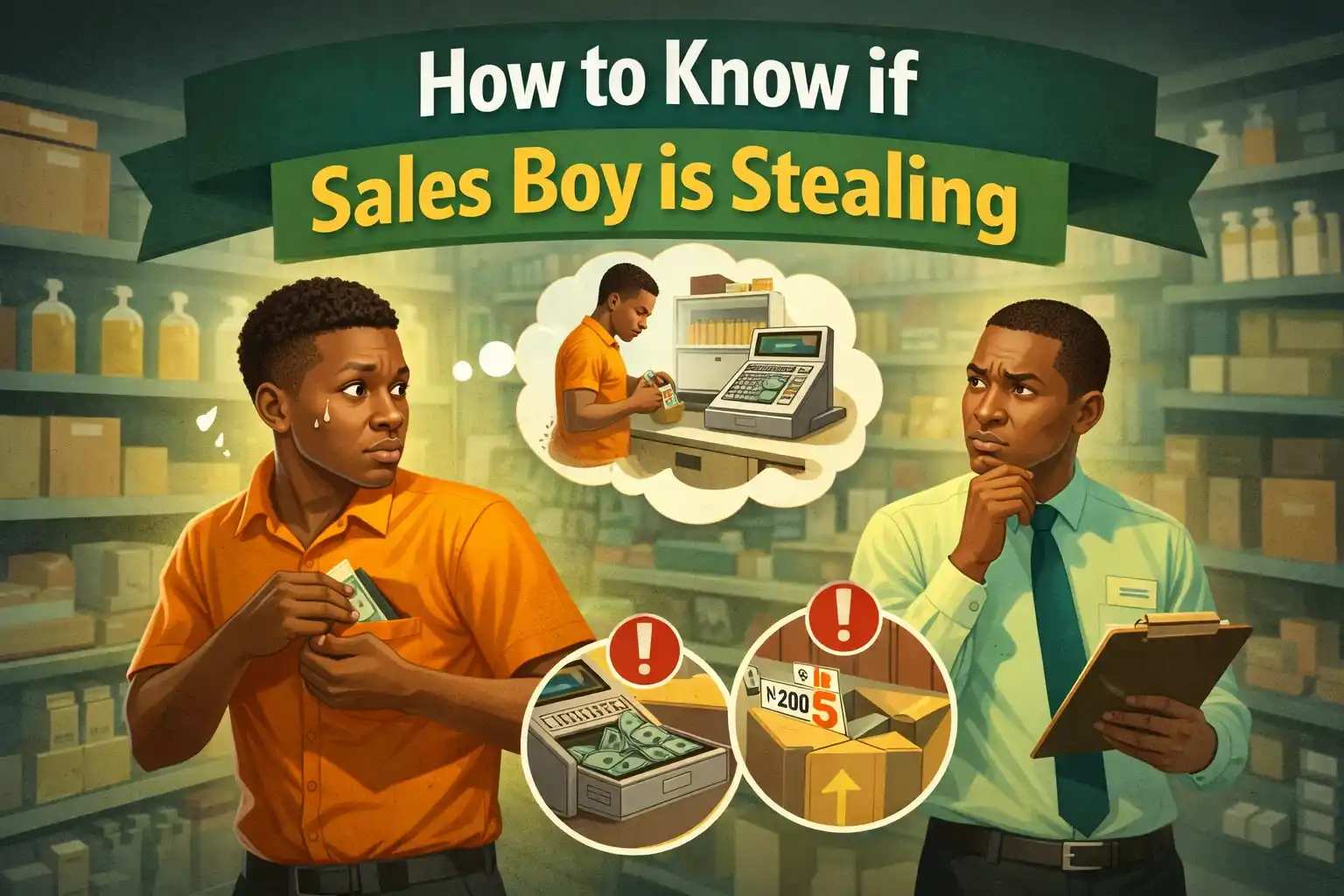
There's a case I heard about from World Bank in Owerri, Imo State, that has stayed with me since I first started building MyTreda.
A nwa boi was selling his oga's plaster of paris cement bags at ₦5,000 each. The oga's real price was ₦7,500. The boy had been cutting price — offering customers a bargain, pocketing the difference — and nobody noticed for a long time. By the time it came out, he had sold roughly 100 bags that way.
Do the arithmetic: 100 bags × ₦2,500 difference = ₦250,000. Gone. Quietly, over time, one bag at a time.
The oga didn't catch it because his records couldn't show him what was actually happening. He knew roughly how much stock he had. He knew roughly how much cash came in. But "roughly" is exactly the gap that a dishonest apprentice needs to operate in.
I've heard similar stories from across Nigeria — Onitsha Main Market, Computer Village in Ikeja, Balogun in Lagos, Aba. The markets are different. The products are different. The amounts vary. But the mechanism is almost always the same: a trader with loose, manual records and a nwa boi or sales boy who knows how to exploit the gaps.
My own brother experienced this in Onitsha. His nwa boi would sell items and simply not record them. Not sophisticated fraud — just the simplest thing in the world. Sell. Don't write it down. Keep the money. When my brother finally noticed the discrepancy between his stock and his cash, the damage was already significant. He let the boy go halfway through their agreed years, which is a serious matter in Igbo apprenticeship culture. But what choice did he have? He had no way to prove exactly what had been stolen, or when.
These stories are not about bad people everywhere. Most nwa bois and sales staff are honest, hardworking, and deserve to be treated with respect. But when the system has no checks — when the only record of a transaction is in the head of the person who made it — you are relying entirely on character. And character, under financial pressure, isn't always enough.
This article is about building a system that protects honest staff and catches dishonest ones early, before the damage becomes serious.
Why Staff Theft Is So Hard to Catch With Manual Records
If you use an exercise book or loose papers to track your sales, you already know the answer to this — even if you haven't said it out loud.
Manual records depend on the person doing the recording. If your sales boy is the one writing in the book, then the book tells you exactly what he wants you to know. He can record a sale at ₦4,000 when he collected ₦6,500. He can record half the sales he made. He can "forget" to write down a transaction entirely. He can tear out a page. And you have no way to know any of this, because the only record is the one he created.
Even if you are the one writing the records yourself, an exercise book has no timestamps, no audit trail, and no way to link a specific transaction to a specific person. If something is wrong, you can suspect — but you cannot prove.
The result is that most theft from Nigerian businesses goes undetected for months, sometimes years. By the time the oga notices the pattern, the cumulative loss is enormous, and the evidence is gone.
The Warning Signs You May Already Be Ignoring
Before we talk about solutions, here are the signs that something is wrong. If several of these are true for your business, take them seriously.
Your cash doesn't match your stock movement. You sold what seems like a good amount of products today, but the cash in hand doesn't feel right. You can't prove the mismatch because your records aren't precise enough, but something feels off. Trust that feeling. "Something feels off" is usually your brain recognizing a pattern before you've consciously identified it.
Stock is disappearing faster than sales explain. Products are leaving your shop — through sales, spoilage, or restocking — but when you try to reconcile what came in versus what you sold versus what remains, the numbers don't balance. With manual records, this is almost impossible to catch precisely. With proper tracking, it becomes visible quickly.
Your sales boy is living above his means. New phone. Better clothes. Eating better. Going out more. These things can have innocent explanations. But combined with unexplained stock discrepancies, they deserve attention.
Customers report buying at prices lower than your set price. This is exactly what happened in Owerri. If a customer tells you they bought from your shop at a price you didn't set, your staff is cutting price and pocketing the difference. One report could be a mistake. Two is a pattern.
Your busy periods don't show in your cash. Market days, end of month, festive season — your shop is visibly busy, but the cash doesn't reflect the traffic. Busy periods are when dishonest staff take the most, because high transaction volume makes it easier to lose things in the noise.
Staff become nervous or defensive when you check records. A sales boy with nothing to hide doesn't mind you reviewing the day's sales. One who does mind is telling you something.
How Theft Actually Happens — The Most Common Methods
Understanding the method helps you close the specific gap.
The unrecorded sale. The simplest and most common. Customer pays. Staff pockets the money. Nothing is written down. No trace. Works perfectly when there's no system to flag that a transaction happened at all.
The under-recording. Customer pays ₦8,500. Staff records ₦5,000. Pockets ₦3,500. The record exists, which makes the staff look legitimate, but the amount is wrong. Hard to catch without knowing the real price of every product sold.
The cut-price scheme. As in the Owerri case — selling below your set price, pocketing the difference. The oga gets approximately what they expected per item, so the overall revenue might not look dramatically wrong. But over hundreds of transactions, the accumulated difference is substantial.
The return fraud. Customer returns a product. Staff processes the return, refunds the customer, but pockets the money instead of returning it to the float. Without a system that logs returns separately and ties them to original transactions, this is nearly invisible.
The stock removal. Products taken directly, not through a sale. Easiest in busy shops where nobody is counting stock regularly. A bag here, a carton there, over weeks and months.
What Actually Stops It
The good news is that none of these methods work when there is a proper record system in place. Not because thieves suddenly become honest, but because the opportunity disappears.
Every sale must be recorded by the system, not just the person
The fundamental shift is moving from a system where the staff member controls the record to one where the system creates the record independently. When your nwa boi processes a sale in MyTreda, the system logs it: what was sold, how much, at what price, and exactly when. You can see this from your own phone, from anywhere, at any time.
He cannot delete it. He cannot change the amount after the fact. He cannot "forget" to record it — because the stock update happens automatically when the sale is recorded. If a product leaves the shelf but no sale is recorded, the gap shows up immediately.
Every transaction needs a timestamp and an identity
When did the sale happen? Who processed it? These two pieces of information make most forms of staff theft significantly harder. If your records show that 15 sales were processed between 2pm and 5pm, but your sales boy tells you only 10 customers came in, you have a direct, specific discrepancy to investigate. Without timestamps, you have nothing.
Regular stock reconciliation is not optional
Once a week, count your stock. Compare it to what your system says should be there. Any unexplained gap is a problem that needs an explanation. Most traders don't do this because manual counting is tedious and imprecise. With a digital system, it takes minutes and the comparison is automatic.
The Owerri trader with the plaster of paris bags might have caught the problem after 10 bags if he'd been doing weekly counts. Instead, it ran to 100 bags because there was no regular check.
Set prices in the system — not just in your head
If your product prices are stored in your inventory system, a staff member cannot process a sale at a price you didn't set. The system won't allow it. This directly closes the cut-price scheme. Every transaction goes through at the price you established.
Separate the person who handles cash from the person who records sales, where possible
If the same person takes payment and records the transaction, there's more room for manipulation. Even in a small shop, if you can review the records at the end of each day and reconcile them against the cash in hand, you've added a layer of accountability that makes theft significantly riskier for the person doing it.
A Word on the Apprenticeship System
I come from an Igbo family. The nwa boi system — where a young person lives with and learns from an oga — is a genuine institution. It has created successful traders across Nigeria for generations. It is built on mutual obligation: the boy gives years of service, the oga gives trade knowledge and a settlement at the end.
When it works, it works well. When it breaks down, it often breaks down over money — specifically, over the absence of clear, verifiable records of what happened.
I had a friend who served two ogas over twelve years. First oga, six years — let him go without settlement, accused him of stealing. Second oga, six years — gave him ₦1 million and released him properly. On his way back to Lagos from his village, after finally receiving his settlement, he died in a motor accident.
Twelve years. Two ogas. One proper settlement. One tragic end before he could even start.
I'm not saying bad record-keeping caused my friend's death. But I am saying that the dispute with his first oga — the accusation that ended twelve years early without evidence or resolution — would have been impossible if there had been a proper audit trail. An oga who can show exactly what was sold, when, and by whom doesn't need to make accusations. He has proof. And an honest nwa boi who has been falsely accused has something to point to in his defence.
Better systems protect both sides.
What to Do If You Suspect Theft Is Already Happening
Don't accuse immediately. Accusations without evidence damage relationships, create enemies, and can backfire if you're wrong.
First, get your system in order. Start recording every transaction properly from today. Do a full stock count now — everything in your shop, counted and recorded. This is your baseline.
Over the next two to four weeks, compare what the system shows you sold against the cash that actually came in. Compare your current stock count against what the system says should remain. If the numbers consistently don't align despite proper recording, you have something concrete to work with.
Then you can have a specific conversation: "On Tuesday, the system shows three bags were sold for ₦7,500 each. The cash for that day is short by ₦9,000. Help me understand." That is very different from "I think you are stealing from me." One is a business conversation backed by data. The other is an accusation that the person can deny, and which may be wrong.
If the discrepancies continue after you've established a proper system, you have your answer. And you have the evidence to act on it.
The Broader Point
Running a business with people you trust is not the problem. The problem is running a business where trust is your only control mechanism. Even in families, even between the closest people, money creates tension and temptation. Systems that verify don't mean you distrust your staff — they mean you've removed the conditions that make theft possible in the first place.
Your staff should know that every transaction is logged, that stock is counted regularly, and that any discrepancy will be investigated. That knowledge alone changes behaviour. Most petty theft stops when people know they will be caught. The ones who continue anyway are showing you something about their character — and you'll catch them quickly.
Protect your business. Protect your honest staff. And give yourself the information you need to make decisions based on facts, not suspicion.
Ready to try MyTreda?
Join thousands of Nigerian traders managing their business better with MyTreda.
Get Started TodayWritten by
Tochukwu Nwosa
The founder of MyTreda Technologies Ltd. He grew up in an Igbo trading family, watched his brother lose money to an untracked apprentice in Onitsha Main Market, and built MyTreda so other Nigerian traders don't have to go through the same thing. He lives and works in Lagos.